Attenborough 100
The 8th of May 2026 is Sir David Attenborough’s 100th birthday.
Like many people my age, he’s been a hero of mine since I was a child, a constant in my life, and a true inspiration. His impact on my own life, my interests, and even where I live has been profound, so I decided I’d post a little tribute of my own to go with the many I’m sure he will receive.
Happy 100th birthday Sir David!
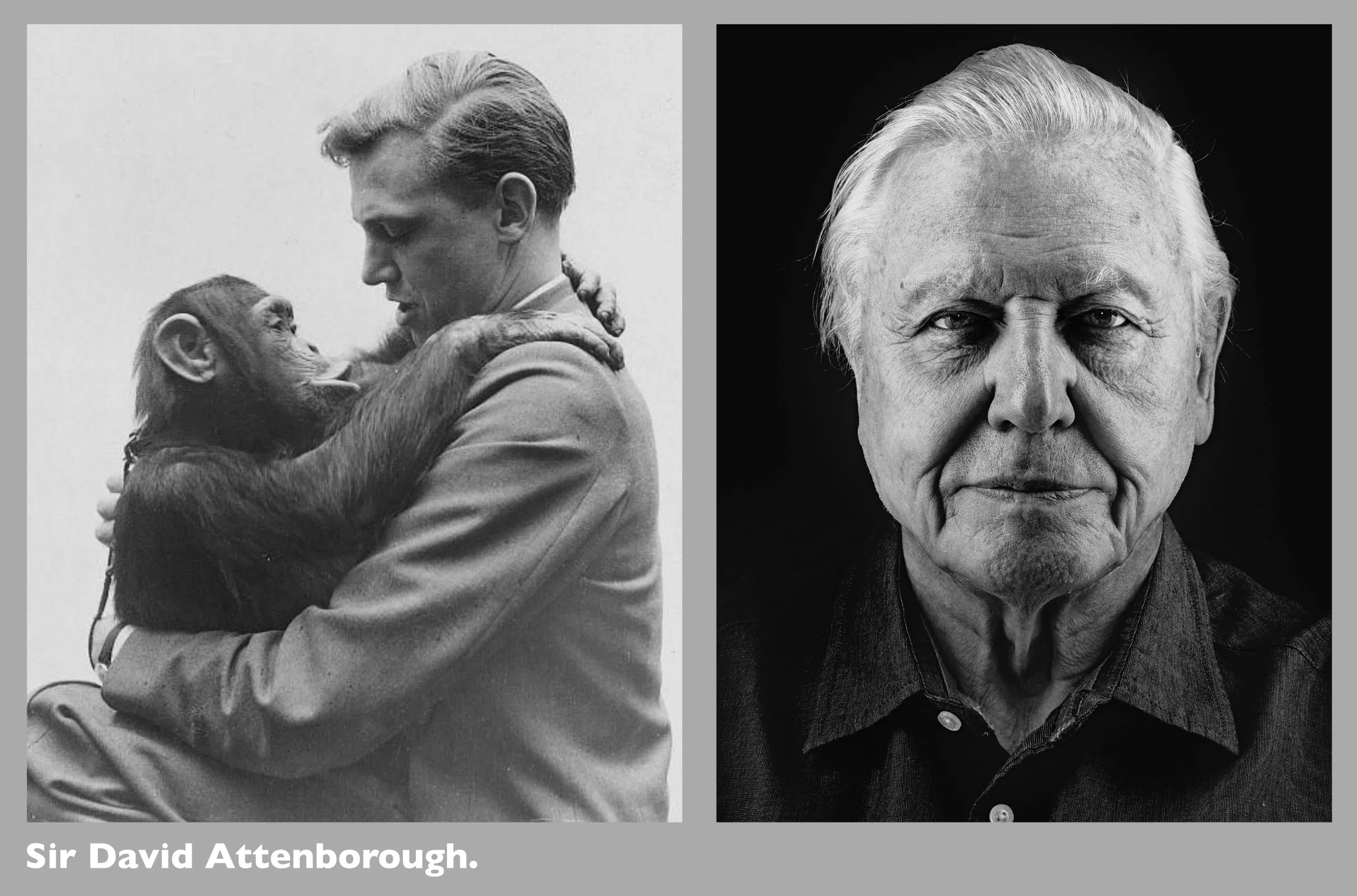
I've always had a vivid imagination; as a young child, I never needed to watch or read anything scary in order to conjure up monsters. A moonlit tree, or flickering shadow was all that was required to summon up nightmarish creatures. My mom would always counter this by making light of things, trying to convince me that “there were no such things as monsters”, but this only succeeded in reining in my imagination temporarily.
One day, a well-spoken, well-dressed man called David appeared on my TV screen. He was talking animatedly about animals I'd never heard of or seen before. These were giant creatures that lived long ago, they had sharp claws, enormous teeth, and some were as big as a bus. I felt vindicated, monsters did exist, I'd been lied to.
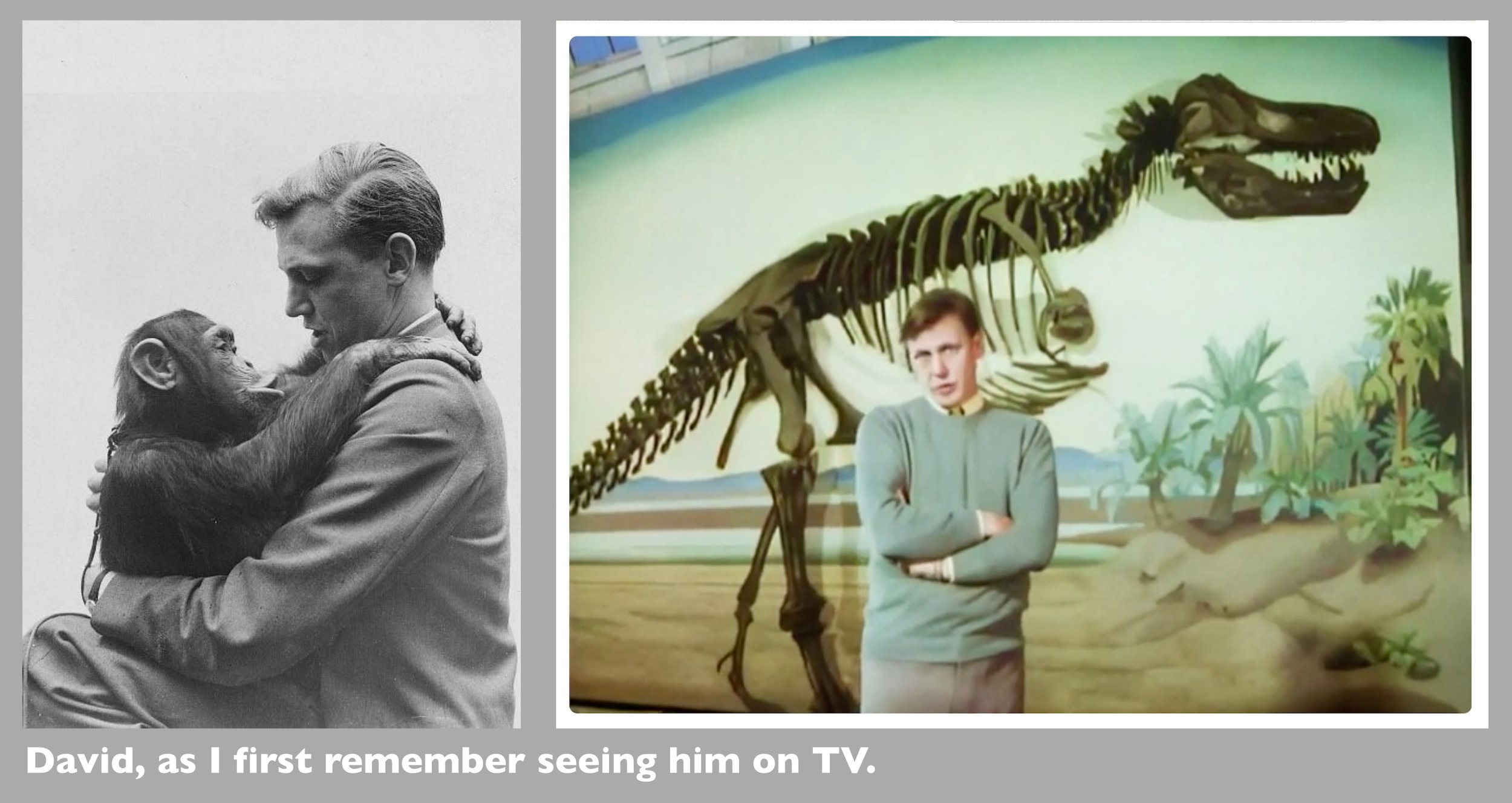
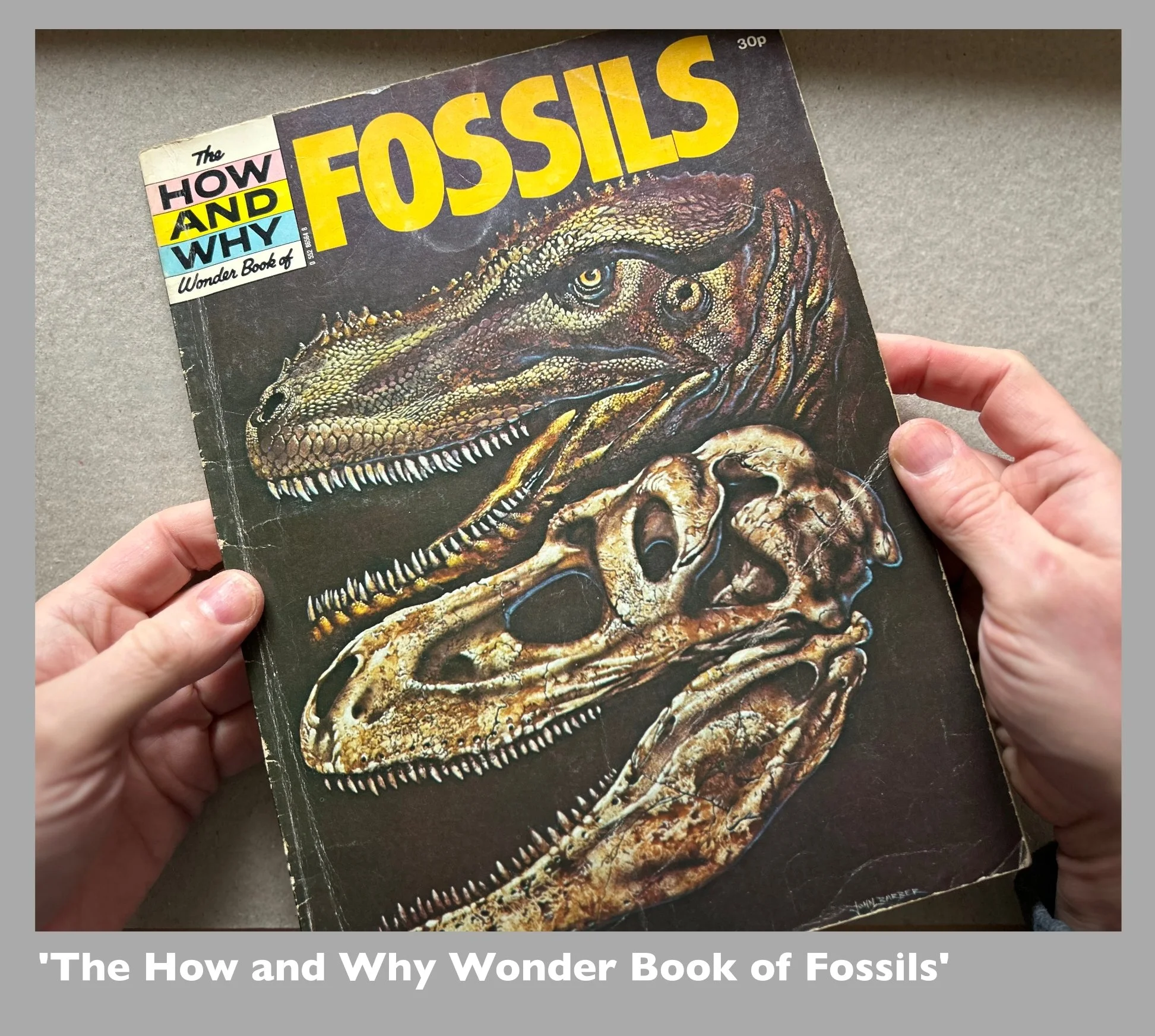
I now believed what David said above and beyond my parent’s weak explanations, after all, he was a scientist, he was on TV, and he knew lots of big words. Anyway, intrigued, I decided that I'd like to learn more. Later that year, the travelling book library came to school and, as a treat, I’d been given some money to buy a book. The other children typically crowded around the latest story books, the many beautiful picture books, but I headed straight for the very books I wanted . . . the science books, books about animals, and dinosaurs! I bought myself a book called ‘The How and Why Wonder Book of Fossils’, it cost me 30 pence. I then spent the following weeks devouring this new, exciting information. Dinosaurs were not only real, but you could still find evidence of them in the rocks beneath our feet, all this time later! People had discovered dinosaur bones, teeth, horns, and even fossilised poo! Amazing.
Soon after, my friend David appeared on the TV again, this time leafing through an enormous old book, talking about myths, legends, and fantastical creatures. This was a whole new series called. . . “Fabulous animals”, and I was hooked. I spent an entire week's pocket money on the children’s book which accompanied the series and before long I was an expert on mermaids, dragons, and monsters . . . all of which I knew were magical and made-up, but David brought them to life with his energy and enthusiasm.
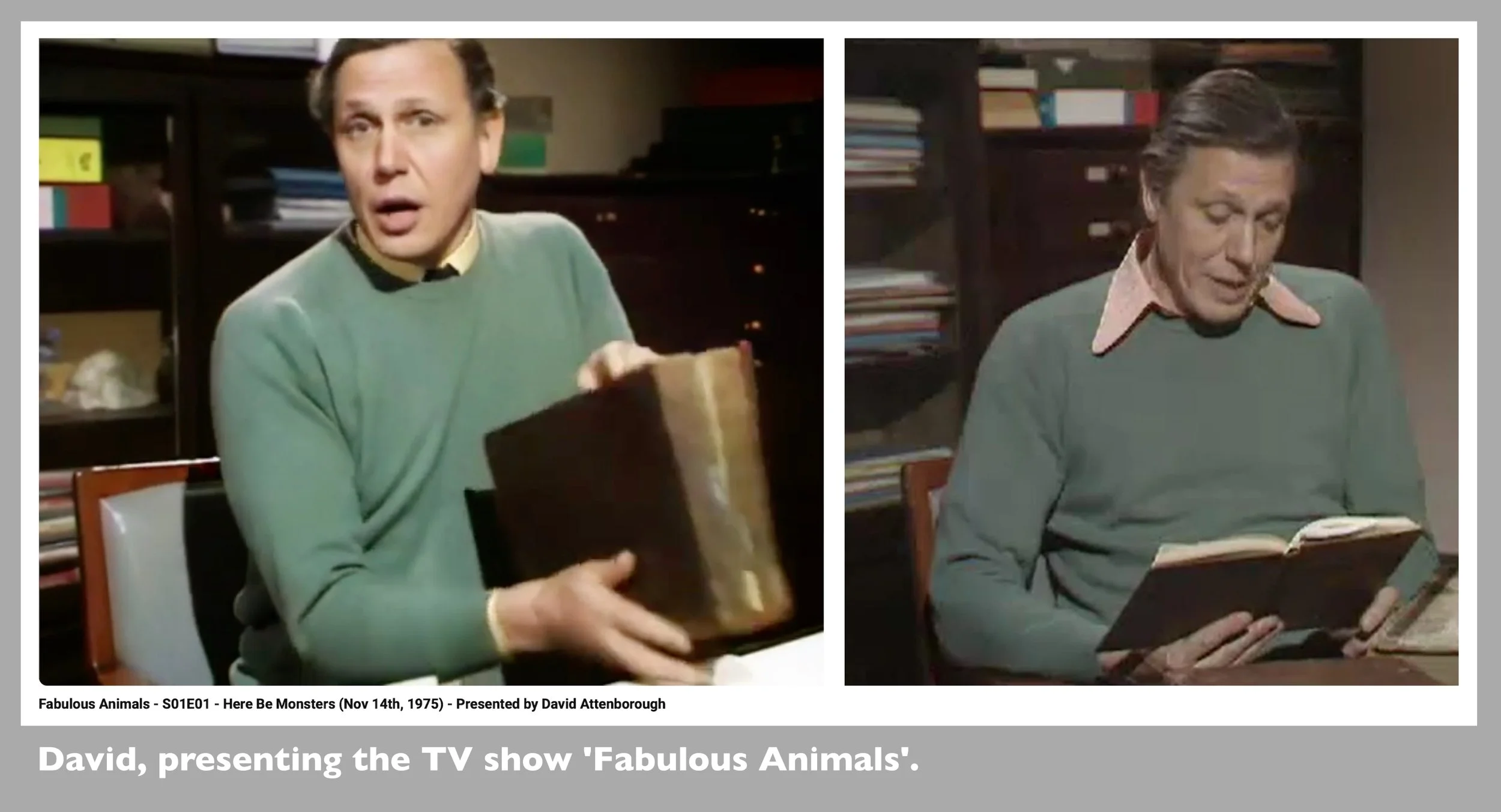
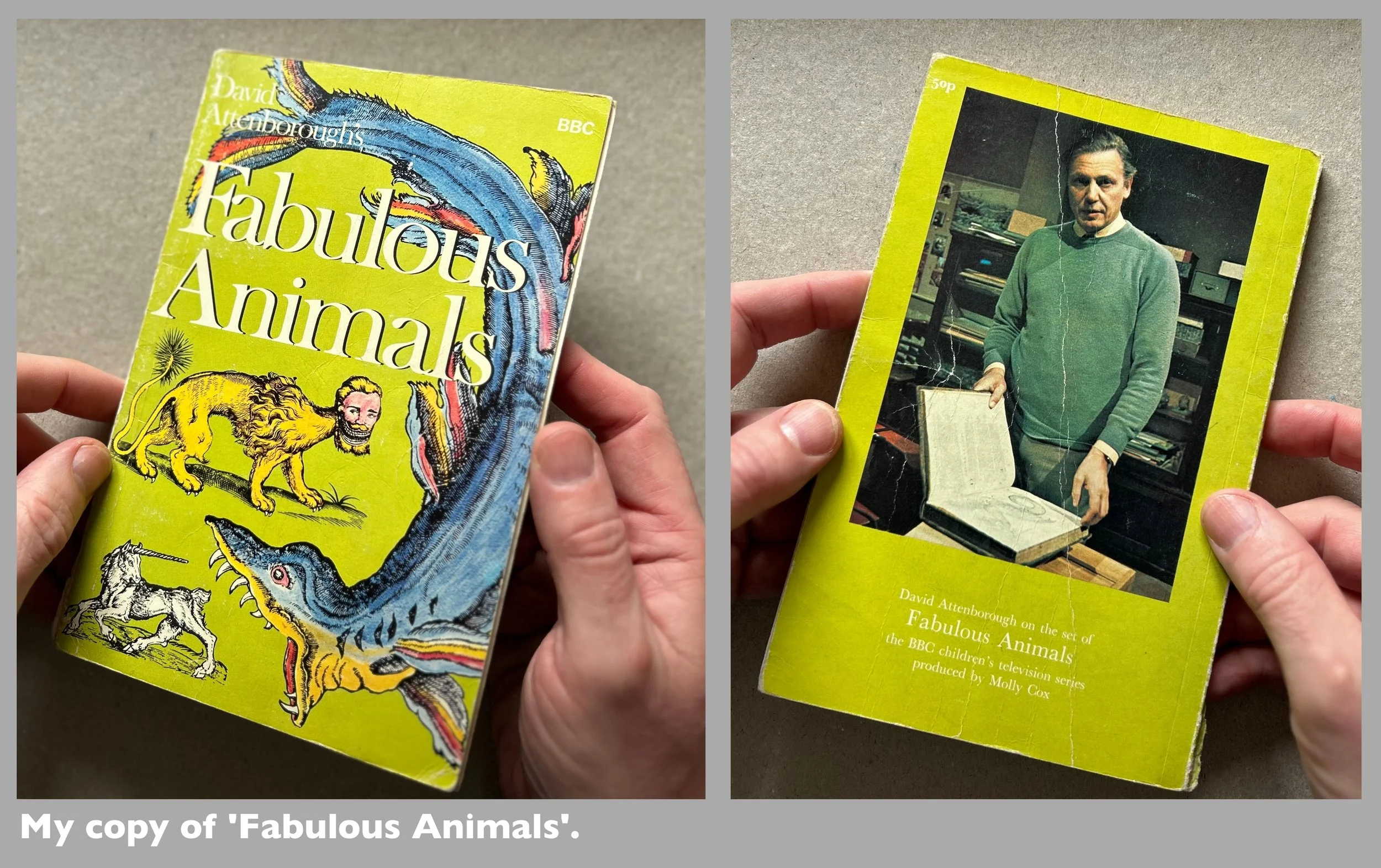
Dinosaurs continued to be a huge part of my childhood. I amassed a hoard of small plastic models of them, and I'd begun to collect fossils myself too, some which I'd bought during a trip to the Natural History Museum, but many that I'd found myself at Wren’s Nest Hill, a quarry in Dudley. I used to go there on my own on the bus with just a plastic bag and a hammer, then I’d come home and bash the rocks open in the garden to see what I'd found!
When I was 9, David appeared on TV again advertising his next series. This was a big-budget primetime show all about animals called “Life on Earth’. I eagerly watched every episode, captivated by both the creatures and my now famous friend. Then, on my 10th birthday I got the best of presents. Not only was I given the book that accompanied the series, but I got to go to a signing! In my head, I'd already known David for over 5 years now, so it seemed rude to visit him without taking something, so I drew him a picture. I remember rolling it up and playing nervously with it while we waited in the queue. When it was our turn, everything happened so fast. I pushed my copy of the book forward, David scribbled his autograph, I smiled and then I pushed the scroll towards him saying “This is for you”. Everything slowed, he carefully took the picture in both hands, unrolled it like a precious document, gasped, and said “A Tyrannosaurus Rex if I've ever seen one.” I remember this, in my heart, like it was yesterday. My friend liked his present.
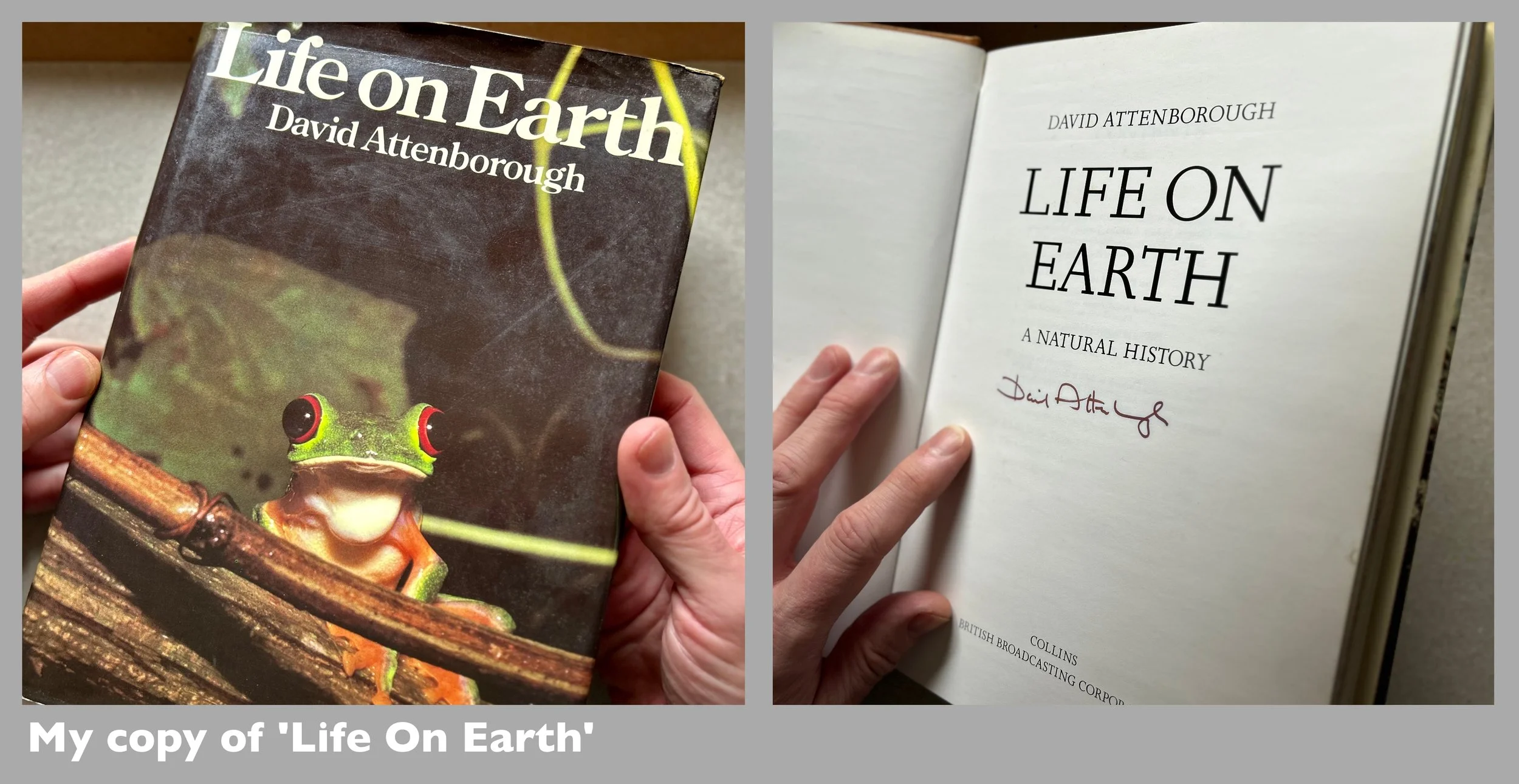
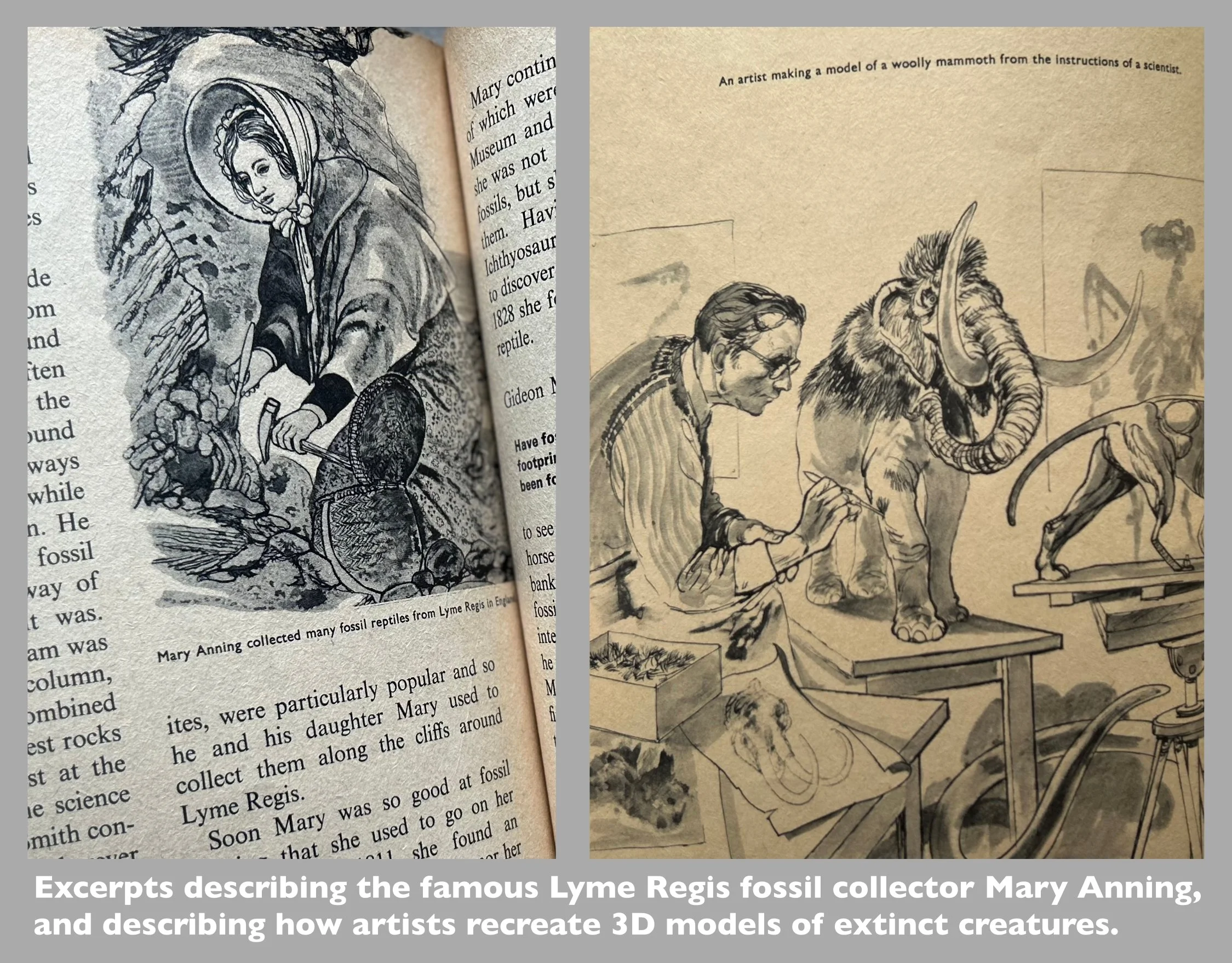
In my teenage years life took over. Exams, art, music, girls . . . but throughout this time two remnants of my childhood hung around. A love of animals and nature, and an interest in geology and fossils. When I began teaching in my early twenties, if I got any time off, I'd invariably head down to the Dorset coast and walk the famous beaches there, looking for ‘treasures’. I'd read all about Lyme Regis as a boy, back in that very first ‘fossil’ book there’d been a whole page dedicated to Mary Anning, ‘the fossil girl of Lyme Regis’. So, this place already seemed familiar to me, even before I'd set foot here. When I decided to go freelance in my mid-thirties, I realised that it didn't really matter where I was based. Things would either work out, or not, regardless of where I was living. So, I moved to Lyme Regis and began to get work and contacts in the Dorset area.
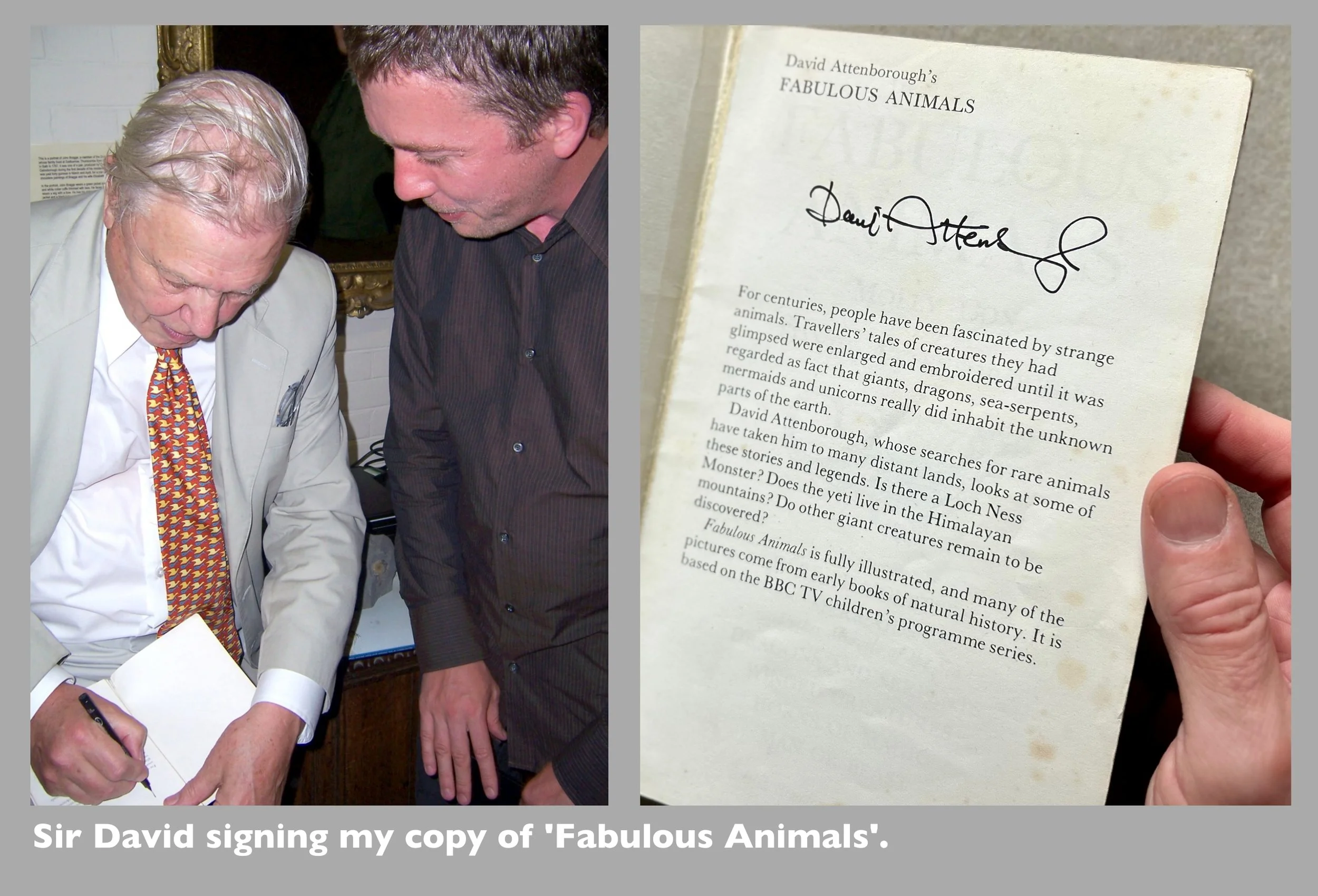
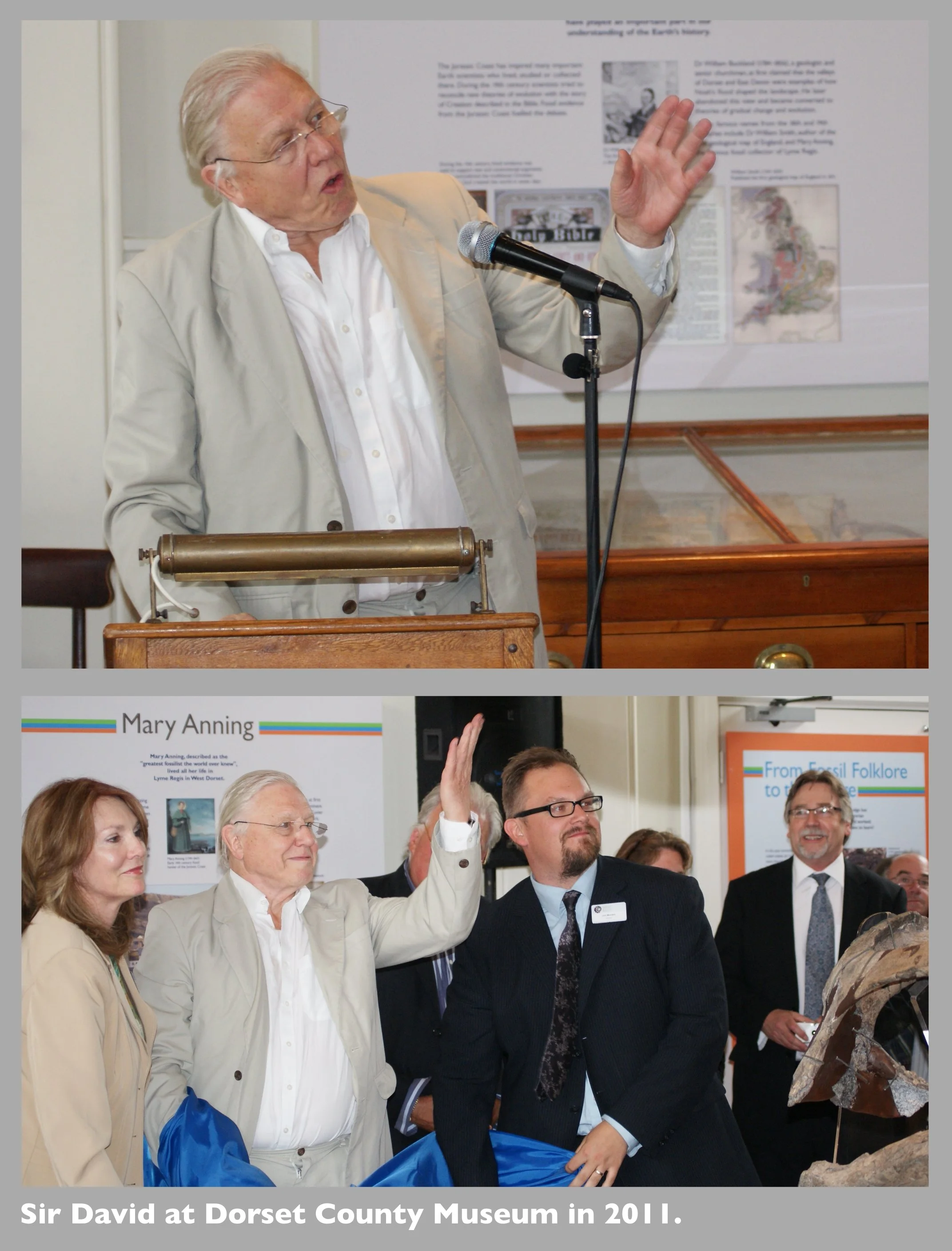
The local museum service already arranged lots of exciting days for children, and soon I’d got myself into a number of the museums, making large scale prehistoric creatures or fossil skeletons. Then, one day, I had an exciting call. I'd created some artwork for Dorset County Museum, constructing models of dinosaurs for their brand new ‘Jurassic Gallery’. The lady who I’d worked for asked if I'd like to come to the opening ceremony. I thought it might be useful for networking and then she dropped a bombshell, it's being opened by David Attenborough. Incredible! So, I found myself in a relatively small gallery space, drink in hand, alongside a small group of about sixty people, waiting for my old friend to arrive. When he appeared, you almost didn't notice him, quietly spoken, unassuming, gentle, with almost a shyness about him. He shuffled along shaking hands with the important guests and museum representatives and then he sat, waiting to speak. Other guests droned on through their introductions and thankyous, until finally, David was introduced and he rose to speak . . . and a light came on, not an electrical one, a light inside of him. He became what he is on television, he switched himself on, increased the volume, the sharpness, the contrast. He spoke beautifully, with charm, knowledge, and charisma. No notes, no pauses, no “erms” . . . eloquent, precise, and thoroughly captivating. It was at this point that I really understood why I'd been fascinated by him as a child. He is, and always has been, a truly gifted communicator. After the speeches, I joined an excited line of young children that had formed to get his autograph. Funnily enough, just as I joined this impromptu queue, a group of other adults suddenly became brave too, and followed behind me. They were all clutching copies of David’s latest autobiography “Life on Air”, but what had I bought with me to be signed? My copy of ‘Fabulous Animals’ . . . 50 pence from WHSmith’s in West Bromwich in 1975. When he saw it, he laughed and said, “A blast from the past”. He signed it swiftly and moved on. I began to wish I'd taken a rolled-up dinosaur drawing with me.
Strangely enough, like deja vu, I got another invite about five years later. Once again, I’d created work for the local museum service. This time around, they'd acquired a very special new exhibit, an enormous Pliosaur skull, as big as a car, with teeth the size of bananas . . . the stuff of nightmares! Anyway, I got another call . . . “We're having an unveiling . . . Attenborough’s coming!” Of course I went. Again, David spoke of his love of geology, of fossils, and of this specific stretch of coastline. I was mesmerised. I took my camera with me and only realised about 10 minutes in that I hadn't taken a single shot, I'd forgotten why I was there, his words had swept me up and I was a boy again. I didn't get anything signed this time or talk to David, I stood back, I thought others should have his time. I watched him though, watched with delight as he ignored the important dignitaries and chose to play peek-a-boo with some of the little children, his face becoming playful and animated like an ageing chimpanzee. They laughed, they wanted him to play more, they had no idea who he was, but they were drawn to him anyway.
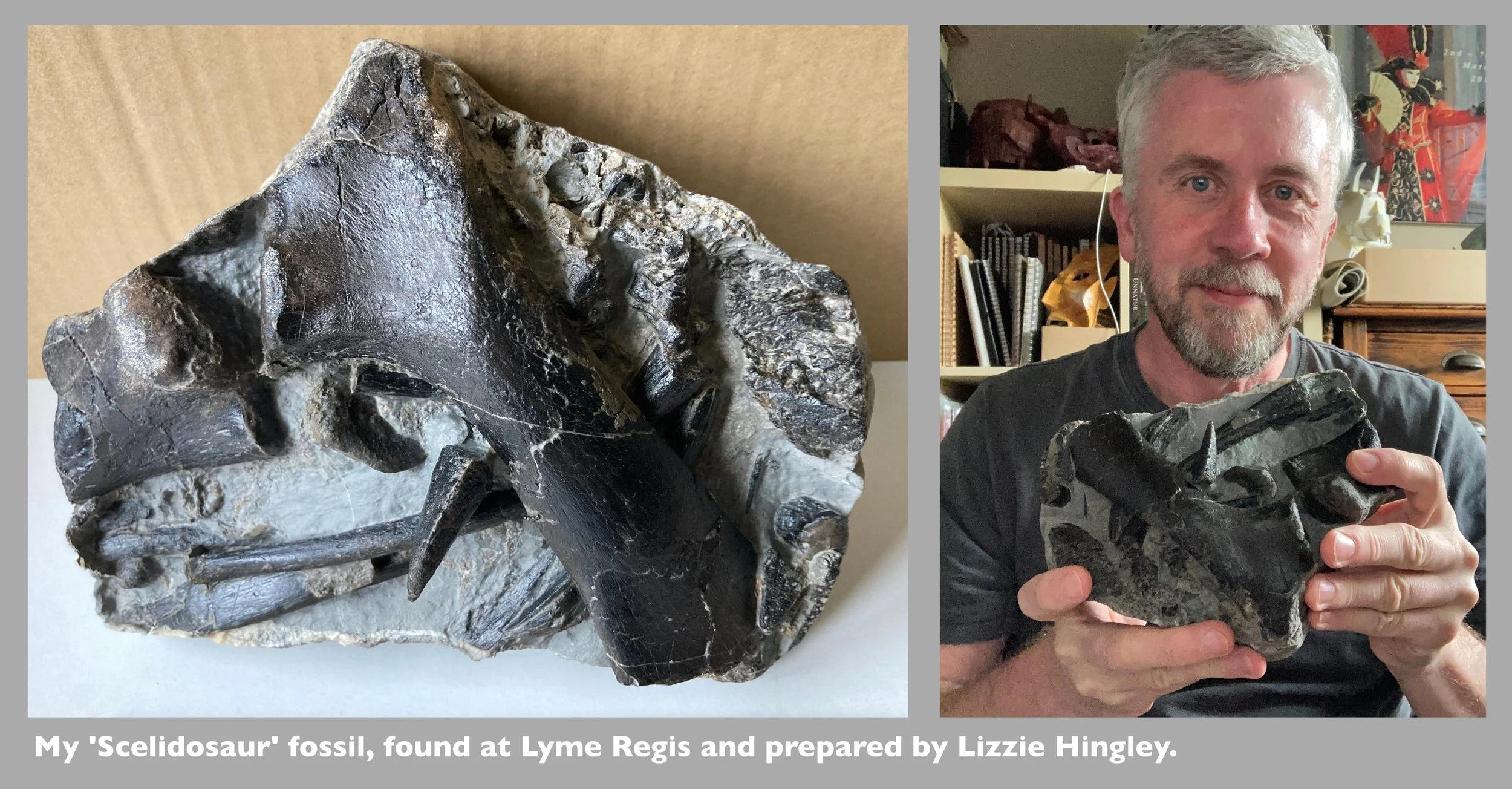
About four years ago I made a decision. I'd collected fossils now for most of my life, and I had a small selection that were worthy of being professionally prepared. It's fairly costly, but I decided to spend some of my savings getting these specimens cleaned up. Preparators use special tools to remove the rock surrounding fossil specimens and to preserve what's there. I asked a local professional, Lizzie Hingley, to do this work for me. She's not only an expert, and a collector herself, but she's got an art background too, and I love the originality of her work. In the course of preparing one of these fossils, Lizzie realised that it was a lot more unusual than I'd originally thought. Instead of being a cluster of bones from one of the many sea creatures found here, it was actually from a land animal, a Scelidosaur, one of a herd that had been washed out to sea in some ancient catastrophic event. Other specimens, of all different ages, have been discovered in this one specific location, but they’re rare. I was delighted; I’d found my own dinosaur! So, I thought, I'll tell David about it.
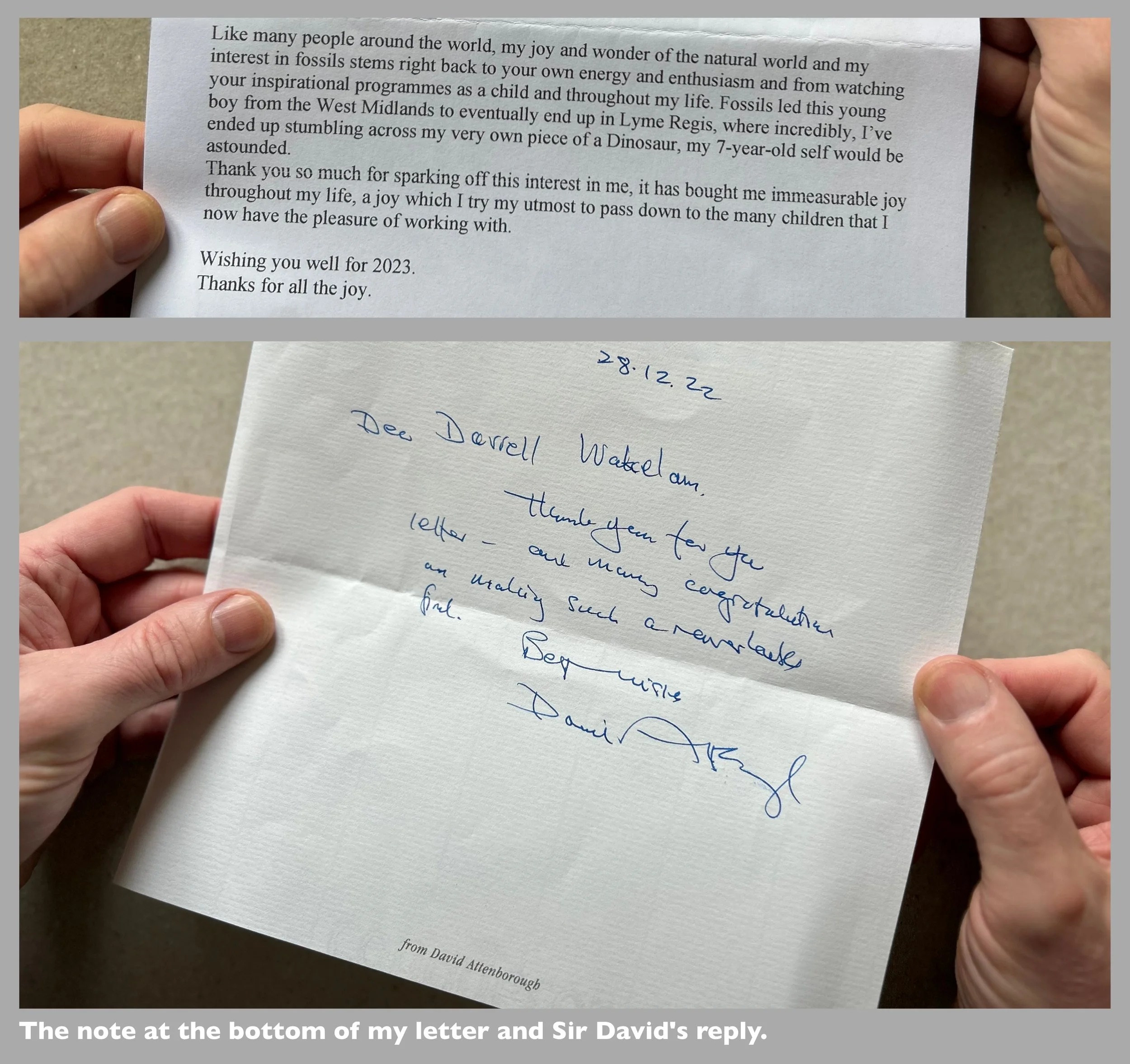
I wrote David a letter, included photos of the fossil that I'd found and told him about it, and how delighted I was. Amazingly, he wrote back. Only a short note, but full of the excitement I expected.
“Thank you for your letter - and many congratulations on making such a remarkable find.”
Best Wishes, David Attenborough
So, with that note, I had my third signature. The first, inside my ‘Life on Earth’ book from when David was 53 (and I was 10). The second, in my ‘Fabulous Animals’ book, when he was 80 (and I was 37), and this short note, signed by him, aged 96 (when I was 53, coincidentally, the same age as he’d been when I’d first met him in 1979).
In my letter to him, I couldn't let the opportunity pass without explaining a little about what he meant to me, so at the bottom I signed off like this . . .
Like many people around the world, my joy and wonder of the natural world and my interest in fossils stems right back to your own energy and enthusiasm and from watching your inspirational programmes as a child and throughout my life. Fossils led this young boy from the West Midlands to eventually end up in Lyme Regis, where incredibly, I’ve ended up stumbling across my very own piece of a Dinosaur, my 7-year-old self would be astounded.
Thank you so much for sparking off this interest in me, it has brought me immeasurable joy throughout my life, a joy which I try my utmost to pass down to the many children that I now have the pleasure of working with.
Wishing you well for 2023
Thanks for all the joy.
Darrell Wakelam
Sir David inspired me to be interested, and curious, and to look closely at what surrounded me. He taught me to be patient, and to find beauty in the smallest and simplest of things. He gave me a love of nature, and an interest in our planet and all of its many secrets . . . and most of all, he taught me that monsters do exist . . . they were here long before we were.